

Floyds Row - The Carlisle Sessions (EP Review)
Beth Isbell | Music Feedback Pro
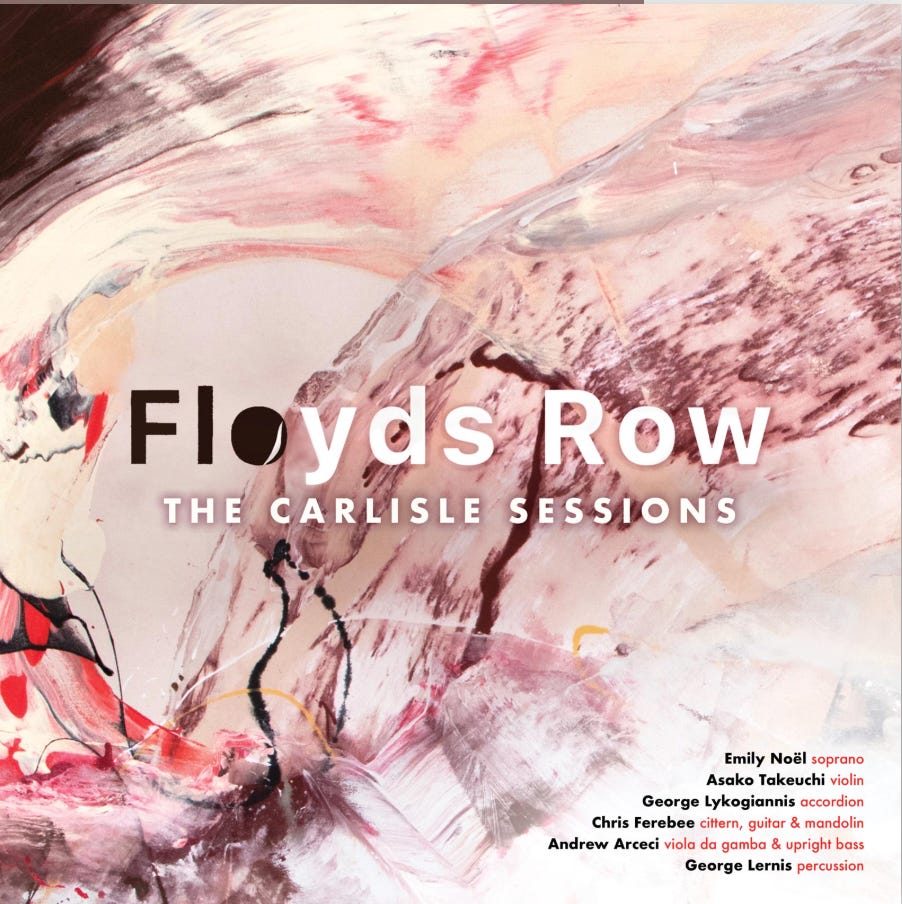
Today’s review features a 5-song classical folk EP by the ensemble Floyds Row titled “The Carlisle Sessions.” Having already listened, this project is phenomenal. So let’s dig in to some of the facts and stories behind the EP.
Recorded in June 2018 at Possum Hall in Carlisle, Massachusetts, USA, the album showcases the ensemble’s unique sound, shaped by its members: soprano Emily Noël, violinist Asako Takeuchi, accordionist George Lykogiannis, multi-instrumentalists Chris Ferebee (cittern, guitar, mandolin) and Andrew Arceci (viola da gamba, double bass), and percussionist George Lernis. Produced by Mac Ritchey and Floyds Row; engineer, mixing by Mac Ritchey, and mastering by Melanie Montgomery.
The ensemble is dedicated to exploring “the old, forgotten and obscure.” Floyds Row approaches traditional music as a living art form — one that can be rediscovered, reimagined, and renewed through performance.
The New EP is scheduled for release on August 21st on Big Round Records. So let’s start with what their label says about the new EP: “Take a trip back in time with Floyds Row, a folk collective who seeks the old, forgotten, and obscure. On The Carlisle Sessions, the group unearths and brushes the dust off of musical relics and freshens them anew with contemporary folk-classical flair, reviving five musical tales that tell epic tales of swashbuckling, recount the tale of Robin Hood, and inspired George Washington to cut a rug.”
The music press has also weighed in, “Floyds Row has developed into a folk-classical collective, pulling from early, folk, and classical idioms. What began as an Oxford-based project has blossomed into a touring ensemble on notable stages across the United Kingdom and United States, with a critically appreciated album that merges chamber elegance with folk resonance.” – BroadwayWorld
Floyds Row explores the connections among early, classical, folk, newgrass, and world genres. The ensemble evolved from a series of concerts at the University of Oxford. These first collaborations — organized by Chris Ferebee, along with Alistair Anderson, Andrew Arceci, and several guest musicians — led to their début recording, The Oxford Sessions (Centaur Records). Following their debut album, Floyd’s Row explored the intersections of historical repertoire, folk traditions, and contemporary classical music.
The ensemble has also performed throughout the United Kingdom and the United States, including the American Folk Art Museum; Association of Literary Scholars, Critics, and Writers; Berklee College of Music; Church of the Epiphany (Washington DC); Club Passim; Emmanuel Music; Gaithersburg Arts Barn; King’s Chapel; New Deal Cafe; Museum of Arts & Design; Rockwood Music Hall; The Center for Arts in Natick; and, the Winchendon Music Festival, among other venues.
“Since its inception, Floyds Row has sought out the old, forgotten, and obscure. Despite our differing musical backgrounds in early music, contemporary classical, rock, jazz, and other genres, we found a common love of these old ballads and tunes. We share a desire to re-inhabit them, to utilize their languages — and to bring something of ourselves, of our time, to them. It’s our way of playing a small part in keeping this music alive. While there is a newly composed song on this record, the text of that song came from an 1865 collection of Robin Hood ballads in which the author is unknown. Above all — above our differing musical backgrounds and of the friction of time and style — this record was made with a commitment to both the music and to each other. We hope that you find as much meaning in these tracks as we did.” — Chris Ferebee, the Group’s founder. As Ferebee adds in the EP’s liner notes: “We share a desire to re-inhabit them, to utilize their languages — and to bring something of ourselves, of our time, to them. It’s our way of playing a small part in keeping this music alive.“
The members of Floyds Row each have extraordinary music credentials.
— Soprano Emily Noël, praised for her “sparkling performances” and “sheer vocal beauty” by The Washington Post, and her “alluring clarity and fluidity” by the Wall Street Journal, concertizes throughout North America and Europe in a wide variety of repertory expanding from the Medieval to the contemporary. Ms. Noël has served on the faculties of Franklin & Marshall College, The Community College of Rhode Island, and Notre Dame of Maryland University. She currently is an affiliated instructor at Denison University.
- As a solo, chamber, and orchestral player, baroque violinist Asako Takeuchi has performed with ensembles such as the Wallfisch Band (UK), Collegium Musicum Den Haag (Netherlands), Den Haag Piano Quintet (Netherlands), The Bach Choir & Orchestra of the Netherlands, Arion Baroque Orchestra (Canada), Handel & Haydn Society (USA), Boston Baroque (USA), and folk ensemble Floyds Row. Discography includes recordings with The Wallfisch Band, Arion Baroque Orchestra, and The Bach Choir & Orchestra of the Netherlands.
- George Lykogiannis is a New York City-based pianist, composer, and improvisor. He works extensively in the dance world in the New York metropolitan area, accompanying ballet and modern dance classes for the Mark Morris Dance Group, New York City Ballet, American Ballet Theatre, the Ailey School, Marymount Manhattan College, and Ballet Tech, among others. He holds a Doctorate of Musical Arts (DMA) in classical piano performance from Rutgers University.
- Chris Ferebee is a composer, musicologist, and plucked string player. He holds degrees from the University of Durham (BA, MA) and the University of Oxford (DPhil). His research interests include the aesthetics and techniques of contemporary composition, ethnomusicology, medieval and renaissance music, English music of the 19th and 20th centuries, and the music of Ralph Vaughan Williams.
- Multi-instrumentalist Andrew Arceci has performed throughout North America, Europe, and Asia. As a performer-scholar, he’s collaborated with several museums––Walters Art Museum (USA), National Gallery of Art (USA), Met Cloisters (USA), Art Gallery of Ontario (Canada), Rijksmuseum (The Netherlands), Museu Nacional da Música (Portugal), Chimei Museum (Taiwan), and others.
- Raised in the rich musical traditions of the Middle East and Eastern Mediterranean regions, and later trained in contemporary jazz at the prestigious Berklee College of Music, George Lernis has developed a rare “bi-musical” identity. Alongside his mastery of the traditional drum set, he specializes in regional instruments including the darbuka, bendir, riq, and the microtonal hammered dulcimer, the santur.
Quite the impressive line-up of talent.
So let’s have a listen …
https://www.bigroundrecords.com/catalog/br9000/
Track 01 — George Washington’s Favorite Cotillion (1:39)
Anonymous, arr. George Lykogiannis, Chris Ferebee, George Lernis.
Performed by: George Lykogiannis, accordion; Chris Ferebee, cittern, guitar, mandolin; George Lernis, percussion
The album opens with an instrumental trio — accordion, cittern/mandolin/guitar, and percussion — launching into this irresistible early American barndance. The absence of strings and soprano gives the piece a lean, rhythmically driven energy that makes for a celebratory opening statement.
I love the accordion accompaniment and the melody of this piece, which give it a very happy, celebratory sound, while the percussion adds just the right beats for dancing. The guitar, cittern, and mandolin are played to emphasize the slightly syncopated, danceable percussion. In listening, one can imagine couples, then men in their uniforms and the women in their finest ball gowns dancing merrily to the hypnotic sounds of the band.
The cittern is a plucked stringed instrument that was popular throughout the 16th to 18th centuries. It had a shallow, pear-shaped body with an asymmetrical neck that was thicker under the treble strings. The cittern has a brighter, more metallic, and more percussive ring than a standard acoustic guitar. It’s often described as having a jangly, mandolin-like quality with more sustain than a banjo but less warmth than a guitar. The paired string courses (like a 12-string guitar) create a natural chorus effect that gives it a distinctive shimmer which is immediately recognizable.
The tune itself carries a fascinating historical asterisk. Dance historian Colin Hume points out that the original manuscript by Asa Willcox simply calls it “G: Washington’s Favourite” — the word “Cotillion” is a later addition, and in the original index all three title words were misspelled.
Cotillions were introduced into England around 1768 by French dancing masters and arrived in America around 1772. A cotillion consists of two parts: standard “Changes” danced with every cotillion, and a special “Figure” that gives each cotillion its name. Though Washington’s love of dancing is well documented, there is no direct evidence connecting him to this particular piece beyond the title. Written in D major in 4/4 time and classified as a barn dance, it appears on the CD Jefferson’s Fiddle by William Coulter and Deby Benton Grosjean, described as “a collection of traditional and classical music from the library of Thomas Jefferson,” where it is medleyed with “Corn Rigs Are Bonny.”
Track 02 — Henry Martin (4:42)
Anonymous, arr. Floyds Row
Performed by: Emily Noël, soprano; Asako Takeuchi, violin; George Lykogiannis, accordion; Chris Ferebee, cittern, guitar, mandolin; Andrew Arceci, viola da gamba, upright bass; George Lernis, percussion
The full ensemble enters for the first time here, and with it soprano Emily Noël, whose voice anchors this ancient Scottish piracy ballad at a dramatically different emotional temperature from the opening track.
The song starts with a vocal solo by the soprano Noel over light string drones. Once the story is set by her introduction, the accordion joins in playing a very circus-like bouncing chord progression. Noel’s voice is exquisite and very well suited for this style of music. Eventually, we hear the accordion and violin take their solos. The percussion adds a steady beat. The piece sounds very period-correct. It transports your mind back to the concert halls of old. The full band drops out at the end of the song, except for the string drones likely by the viola da gamba, with Noel providing the bad news of the story - all the men drowned.
The viola da gamba, which is essentially a smaller cello-type instrument, was used extensively in the late 16th to mid-17th centuries in ensemble music such as consorts. It sits somewhere between a cello and a guitar. It has the bowed strings of a cello, but the frets and tuning logic of a lute, the soft intimacy of a chamber instrument, and a vocal quality that no modern string instrument quite replicates. When large concert halls and public concerts became the norm at the end of the 18th century, the viola da gamba could not compete with the louder violin and cello.
The song, “Henry Martin” (also known as “Henry Martyn” or “The Lofty Tall Ship”), is one of those rare folk songs that can be traced to a specific historical event five centuries ago. The real-life inspiration was Andrew Barton (c.1466–1511), a Scottish sailor commissioned by King James IV of Scotland around 1507 to attack Portuguese shipping in retaliation for earlier aggressions against Scottish vessels. This earned him the reputation of a pirate in England, and in 1511 he and his two ships were captured off the coast of Kent. Generations of oral tradition, during which the story was significantly shortened, including the name of the protagonist from Andrew Barton to Henry Martin.
The tale that survived tells of the youngest of three brothers who draws the lot to “turn robber on the salt sea” to support his siblings — encountering a merchant ship, fighting a two-hour battle, and sending it to the bottom.
Folklorist A.L. Lloyd called it “one of the most-sung ballads of our time.”
A landmark 1937 Columbia recording by Phil Tanner proved highly influential. Bert Jansch also recorded a celebrated version in 1966 on Jack Orion. However, it was Joan Baez’s 1960 cover of the song that helped cement the song’s place in the modern folk revival.
Track 03 — Jackaroe (3:56)
Anonymous, arr. Floyds Row
Performed by: Emily Noël, soprano; Asako Takeuchi, violin; George Lykogiannis, accordion; Chris Ferebee, cittern, guitar, mandolin; Andrew Arceci, viola da gamba, upright bass; George Lernis, percussion
The full ensemble continues with another ballad featuring soprano Emily Noël. This time, a Scots-Irish tale of a woman’s courage and devotion. Known variously as “Jack Monroe,” “Jack-A-Roe,” “Jackie Frazier,” and “The Maid of Chatham” — among other names — and classified as Roud. The song tells of the daughter of a wealthy London merchant who disguises herself in men’s attire to follow her lover to war. She arrives amid battle, finds him wounded, nurses him back to health with the help of a doctor, and the pair marry.
It is most likely two or three centuries old, rooted in the troubadour traditions of the British Isles. It was popular as a British broadside ballad in the early 1800s, and American broadsides date back to around 1830, although it could be significantly older. The song can be categorized under a legend historians call “The Main Warrior” and is most likely two or three centuries old, deriving from the troubadours of the British Isles.
The song starts with lovely fingerpicked acoustic guitar arpeggios. Noel’s voice shines in this song. The upright bass provides a nice, solid platform for the other instruments to shine. The accordion provides a period-correct sound. I’m loving the percussion in this tune. Together, they give the song a very danceable feel. I also love how the song ends with “this couple they got married, so why not you and me?” Good question.
The most celebrated traditional version comes from the Ritchie family of Kentucky — folklorist Cecil Sharp collected it from May Ritchie in 1917, and Jean Ritchie released her own recording on Songs from Kentucky in 1956.
Joan Baez’s version, drawn from the Ritchie family tradition, brought it to wide attention during the folk revival and gave it the title “Jackaroe” most listeners know today. The Grateful Dead even adopted and performed it. The Dead’s version keeps the gist of the story, though it leaves out some of the traditional lyrics — in some of the traditional variations there are more details about the central character’s relationship with her father.
Historians note that the ballad is related to “The Bonny Lighter Boy”. It echoes the tradition of “The Valiant Lady” — a timeless story of a woman who risks everything for love, resilient across centuries and continents.
Track 04 — Maiden Lane / Kettle Drum (4:20)
Anonymous, arr. Floyds Row
Performed by: Asako Takeuchi, violin; George Lykogiannis, accordion; Chris Ferebee, cittern, guitar, mandolin; Andrew Arceci, viola da gamba, upright bass; George Lernis, percussion
Soprano Emily Noël steps aside for this purely instrumental pairing, and the five remaining players explore two English country dance tunes that share a remarkable pedigree — both published in John Playford’s landmark The English Dancing Master in 1651, one of the most important documents in the history of folk music. The English Dancing Master is a dancing manual containing the music and instructions for English country dances, first published in 1651 by London-based publisher John Playford. The book had at least 18 editions between 1651 and 1728, and the first edition contained 105 dances with single-line melodies.
John Playford (1623–1686) was a London bookseller, publisher, and minor composer. Under the Commonwealth (1649–60) and for part of Charles II’s reign, Playford almost monopolised the business of music publishing in England. His shop was the meeting-place of musical enthusiasts.
The song starts very slowly, with low-stringed instrument accompaniment, playing a soothing melody, but don’t be deceived; the dance picks up about a minute into the song with the violin (or fiddle) playing a very danceable single-note melody. Loving the bass plucking away underneath. Just after the two-minute mark, all the instruments drop out except the percussion, which goes on an extended drum solo. After a minute, the full band, accordion and all, join back in. The violin sails away in the melody.
Maiden Lane
“Maiden Lane,” written in G major, is a form of longways dance for three couples in rounds of AABBCC. The song takes its name from the small Covent Garden street in London where it was likely known. It first appeared on page 62 of Playford’s first edition as “Mayden Lane”; it remained in the collection through the 10th edition of 1698.
Maiden Lane is considered one of those easy, popular session tunes with three parts to learn — easy to play yet pretty old, first published in 1651.
Notable recordings of Maiden Lane include Brass Monkey on Flame of Fire (Topic Records, 2004), Hesperus on Colonial America (Maggie’s Music, 2003), Bare Necessities on English Country Dances (1987), and Cast a Bell (Beautiful Jo Records, 2001).
Kettle Drum
“Kettle Drum,” by contrast, is written in D Dorian mode in cut time, structured as AABB, and was originally paired with a rather festive and complex round dance with instructions that involved much kissing. It was dropped from the Dancing Master series after the 8th edition of 1690, later revived by Cecil Sharp under the name “Peppar’s Black.”
Notable recordings include The New Renaissance Band on Country Capers: Music from John Playford’s The English Dancing Master (Arabesque 6520), and Cast a Bell (Beautiful Jo Records, 2001).
Both tunes represent some of the earliest preserved English country dance music, dating to the same watershed publication year of 1651. They offer a fascinating window into social dancing and musical life in 17th-century England. These tunes have survived nearly 375 years — composed when the English Civil War had only recently ended — and are still played at folk sessions and contra dances today. That these two tunes still live and breathe in the hands of a contemporary ensemble is a testament to the enduring power and vitality of Playford’s collection.
Track 05 — The Song of Robin Hood & His Huntes-men (3:52)
Music by Chris Ferebee; text from an 1865 collection of Robin Hood ballads
Performed by: Emily Noël, soprano; Asako Takeuchi, violin; George Lykogiannis, accordion; Chris Ferebee, cittern, guitar, mandolin; Andrew Arceci, viola da gamba, upright bass; George Lernis, percussion
The full ensemble returns for the EP’s closing piece, and in an elegant conceptual move, Floyds Row ends not with a recovered artifact but with something entirely new built from ancient materials. It is not a traditional folk song at all — but an original composition inspired by historical material, which serves as the closing statement of the EP.
The song starts with an Appalachian-style single-note acoustic guitar riff, blending the old country with the new Americas. Soon a steady rhythm is provided by the bass and percussion over an eighth-note pattern. Noel’s voice is the star of this piece, singing lyrics crafted from the old Robin Hood tales in folk music. About a minute and a half into the song, the full band, except for a light string drone, falls out while the singer slows her pace to deliver the lyrical information. The full band, with accordion, percussion, and all of the stringed instruments, join back in under the singing. This gives way to a lovely violin solo, then an accordion solo. The acoustic guitar and viola da gamba take their turns. The fiddle soon joins in with a lovely danceable single-note melody to close out the piece.
“The Song of Robin Hood & His Huntes-men” was composed by Chris Ferebee — the ensemble’s multi-instrumentalist and driving creative force — set to text drawn from an 1865 collection of Robin Hood ballads — author unknown. The archaic spelling “Huntes-men” in the title is deliberate, signaling the piece’s conscious rootedness in historical tradition even as this composition steps beyond that old school tradition, and in the process, creates an instant classical folk classic for the ears of a new, modern audience. It’s as if these musical roots have come full circle.
The Robin Hood ballad tradition is one of the oldest and most expansive in English folk music, stretching back at least to the 15th century and encompassing dozens of narrative songs collected by Francis James Child in The English and Scottish Popular Ballads. A related melody, “Robin Hood’s Dance,” appears as early as 1609 in Thomas Ravenscroft’s Pammelia, set to the words “Robin Hood, Robin Hood, said Little John / Come dance before the queene-a.” The Robin Hood’s Dance melody became the signature tune for an entire family of Robin Hood broadside ballads published throughout the 17th century, including Robin Hood and the Beggar, Robin Hood and the Bishop, Robin Hood and the Butcher, Robin Hood and the Tanner, Robin Hood’s Chase, and many more.
Ferebee’s composition honors this deep tradition while bringing something personal and contemporary to it — a fitting final statement for an EP dedicated to keeping old music alive. We appreciate their efforts.
Score/5 Stars: What a truly wonderful and refreshing listening experience. Your ears will love you for listening/buying this EP. Floyds Row takes the listener on the ride of a lifetime - many lifetimes ago - with exquisite musical skill and period-correct precision. This is a phenomenal classical folk EP to be cherished and celebrated for keeping the old folk music alive and breathing new life into its performance for new modern-day audiences to enjoy. Much love, Beth
[We rank albums, EPs and singles on a scale of 1-5 Stars, with 1 = Poor, 2 = Mediocre, 3 = Good, 4 = Excellent, and 5 = Outstanding]
The Carlisle Sessions is available August 21, 2026 on all major streaming platforms via Big Round Records at this website:
https://www.bigroundrecords.com/catalog/br9000/
For more information about this incredible music project, please visit: https://floydsrow.com/